
How to configure a 12-gauge shotgun dedicated to ballistic breaching, from the action and barrel to the ammunition and the gear the breacher carries.
Ballistic breaching uses a purpose-built round fired at contact distance against a lock or hinge. Most teams assign a shotgun to that job alone rather than loading breaching rounds into a general-purpose duty gun.
A dedicated gun keeps things simple:
The T.E.A.R. round was designed first for pump-action shotguns, such as the Remington 870 fitted with a shorter breaching barrel. It also functions well in many semi-automatic models.
Semi-automatic actions vary in how they cycle, so function-test the rounds in the specific shotgun you plan to use before it goes into service.
Shorter barrels are easier to handle in doorways, hallways and stairwells, which is why breaching shotguns are usually configured shorter than a standard shotgun.
Under the National Firearms Act, a shotgun with a barrel under 18 inches or an overall length under 26 inches is a short-barreled shotgun. Agencies acquire and document these through their own ATF process.
Most breaching shotguns carry a standoff device on the muzzle. It serves three purposes:
Placement and angle are covered in agency breaching training and are not addressed here.
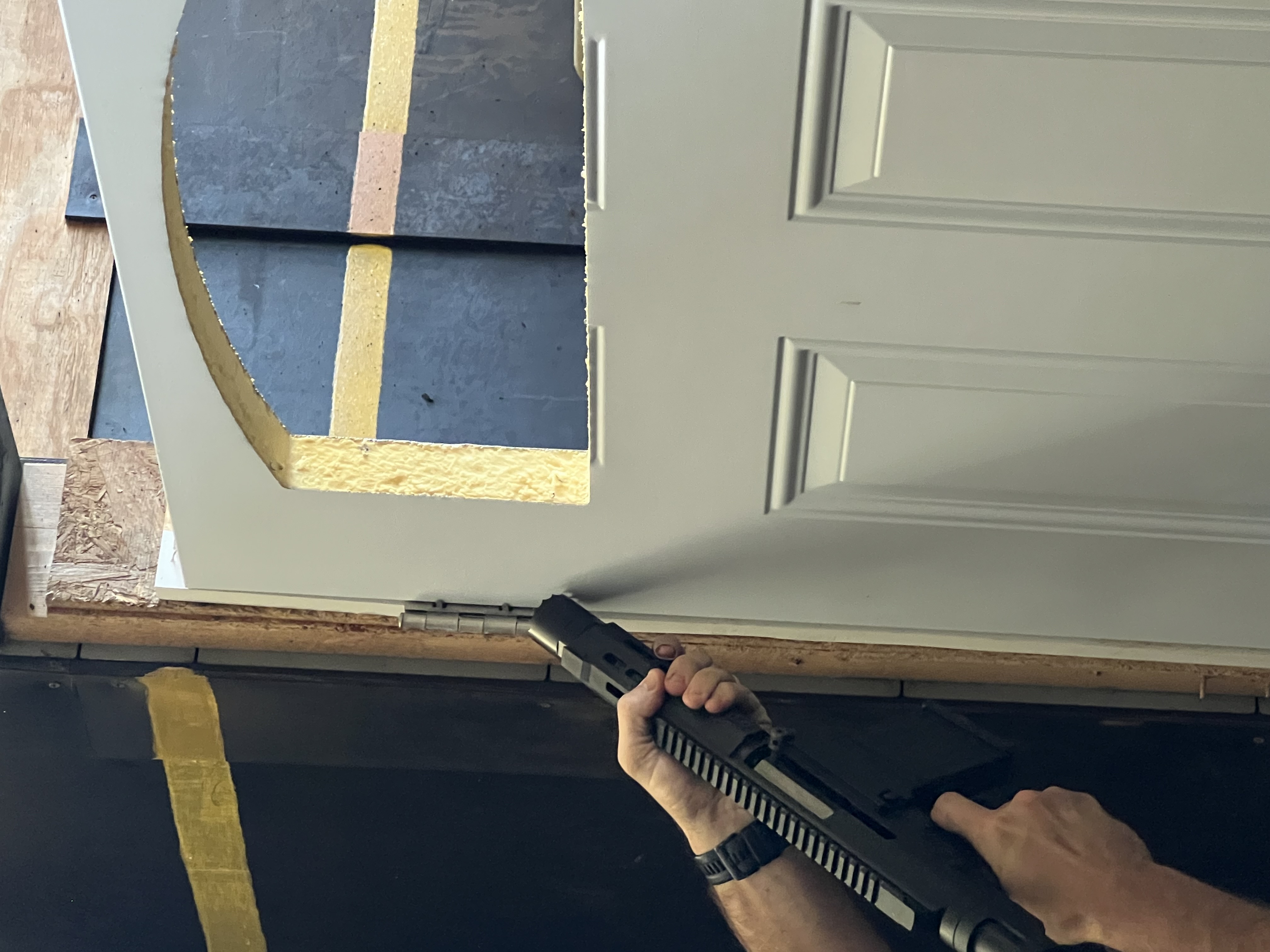
Testing has shown no issues running T.E.A.R. rounds in shotguns fitted with suppressors. As with any change to the muzzle, function-test the combination before deployment.
The T.E.A.R. round is a 12-gauge, 2¾-inch cartridge with a 40-gram frangible, lead-free load. For compact shotguns that cannot run a full-length shell, the Snub round is a 1.70-inch 12-gauge cartridge.
Handling practices:
The breacher usually carries the breaching shotgun in addition to a primary weapon, so the setup has to allow a quick transition between the two.
Breaching rounds are fired at contact distance, so the breacher is close to the door, the hardware and the muzzle.
The objective is one round per hinge or lock, with the muzzle at the correct position and angle, so the hardware is removed with as few shots as possible. Officers assess the door beforehand where they can, often with advance knowledge of the building.
Whether to take the lock or the hinges depends on how the door is built and which way it swings. See how ballistic breaching works for more on choosing a target.
Before a breaching shotgun goes into service:
Many tactical teams are already familiar with ballistic breaching. For teams new to it, specialized agencies and organizations offer breaching courses covering technique, safety and best practice.
Demo kits are available to qualified agencies, so teams can run the T.E.A.R. round in their own shotguns and on their own door types.
Request a demo kitIntegral Hitch products are sold only to law enforcement, U.S. military, and authorized government purchasers. They are not available to the general public.